Business network risk and deployment contract
A proxy result is useful when the application submits the right address and the team understands its role. Record provenance and fallback before enabling customer restrictions.
Summarize with AI
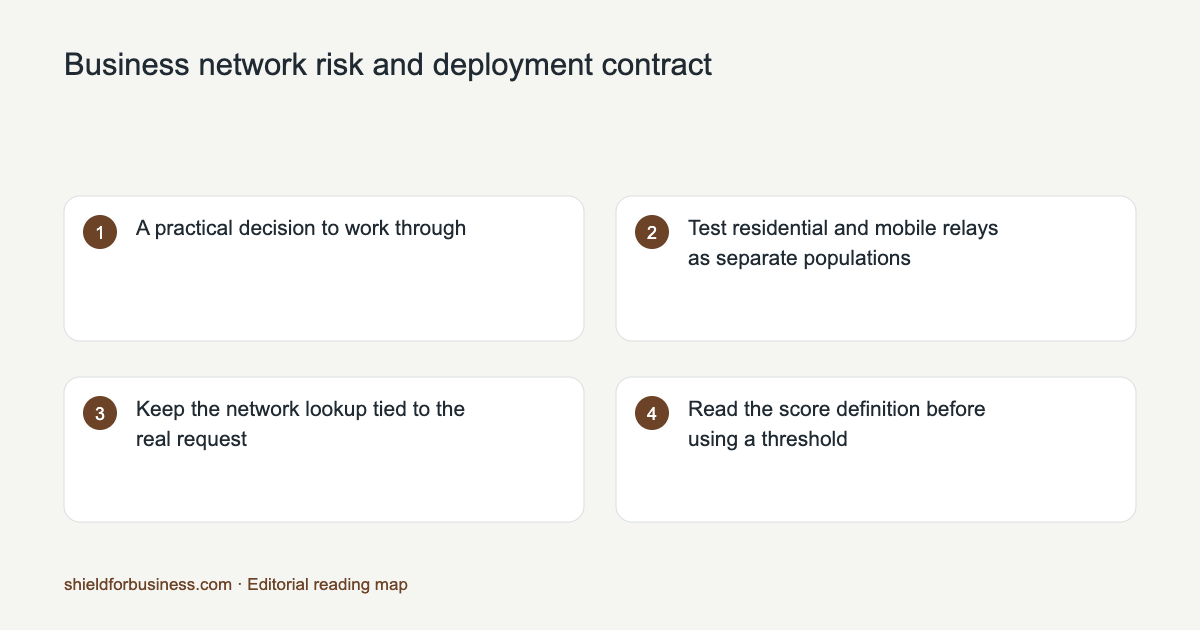
A practical decision to work through
Draw a hypothetical client-to-edge-to-origin path and identify the service that supplies the trusted address. Ask engineering to simulate an outage and stale cache while operations follows the event record. The customer should receive the documented fallback, with the missing observation visible. Keep corporate/remote users in the legitimate cohort so the new policy does not silently break the business's own customer base.
Test residential and mobile relays as separate populations
Treat a residential proxy result as part of the event record. A payment, login and promotion claim may share an IP address while needing different follow-up. Assign responsibility for reviewing clusters and correcting mistaken account associations. MaxMind's reference helps explain category labels, but the operating procedure should also cover missing results, delayed lookups and legitimate shared networks. Avoid making an entire household prove its identity because one account associated with its address was restricted.
Keep the network lookup tied to the real request
Give engineering a clear contract for proxy checks: the trusted client-IP source, when the check runs and what happens during an outage. Consult the edge header documentation for your actual infrastructure. Do not make a timeout look like low risk. Preserve the event reference and result age so operations can explain why a check affected one action. Keep API credentials in the server-side configuration and avoid writing raw secrets into application logs.
Read the score definition before using a threshold
Use an IP fraud score as a documented input to a workflow, with the provider, scale, reasons and time attached. Operations should be able to distinguish a current lookup from a reused historical value. ShieldLabs combines IP context with visitor, user and device risk, which serves a broader need than an isolated IP check. Keep the decision outcome in the business event record. That makes later corrections possible without quietly changing what the original review actually saw.
Distinguish IP location, device location and travel
A location mismatch should trigger a question about the data source before a question about the customer. Record whether the value came from an IP lookup or a permitted device reading, and include its timestamp and stated accuracy where available. Apple Private Relay can change how network location appears. Connect the result to the account's activity and required action. Where a regulated service requires physical-location assurance, procure that specific capability instead of assuming generic VPN detection supplies it.
Read a privacy checker as a snapshot of exposed information
Public checkers can help a business understand a result before an integration review. They should not be automated against customer accounts or treated as a substitute for the actual production workflow. Use the site's checker directory to locate the appropriate resource, then note the browser, network and observation time if you run an authorized test. The Proxy6 page concerns anonymity output; it does not promise that all other systems will see the same connection in the same way.
Compare network masking detection with account outcomes
A business rollout needs a policy for privacy-network users before it needs a longer IP blocklist. Identify which actions require further review and which can continue with the available context. Use Apple's operational guidance to recognize Private Relay's purpose. Combine the network result with the account's behavior and device history. This avoids making a single shared exit address responsible for signup, login and purchase decisions that carry different consequences.
Sources
- Proxy official source · read
- Shield official source · read
- Ipqs official source · read
- Castle official source · read
- Seon official source · read
- Rest official source · read
- Cache official source · read
- Logging official source · read
- Headers official source · read
- Oxylabs official source · read
- Brightdata official source · read
- Geo official source · read
- Relay official source · read
- Incognia official source · read
- Fpprivacy official source · read
- Authorization official source · read
- Boost official source · read
- Proxy6 official source · read
- Fraudfoxpaper official source · read
Continue reading
- Business account security owners and controls
- Business device intelligence and data boundaries
- Business benefits seats and eligibility
- Business commerce risk and operational handoffs
- Business fraud reporting and legitimate outcomes
- Business fraud procurement and specialist evidence
- Fraud api integration checklist
- Referral and coupon fraud
- Business fraud prevention plan
- Public checkers and vendor demos
- More research guides
FAQ
Which mobile-proxy providers belong in an authorized data-access shortlist?
Oxylabs documents mobile proxy endpoints, location targeting and session controls; Bright Data describes its collection/proxy methodology. Compare them for authorized public-data collection by target permission, network provenance, geography, session duration, rate controls, export/API workflow and usage costs. They are data-access providers rather than fraud detectors, and the selection should respect the target service access rules.
How should a user approach bypass or evasion claims?
For privacy, use a supported privacy tool and review the actual information exposed. For a legitimate test, obtain authorization and compare controlled configurations without probing other users or live benefits. Respect the service access and entitlement rules. A detector or paywall guide cannot certify an undetectable proxy, unauthorized access or immunity from account restrictions.
What does the Proxy6 anonymity check establish?
Proxy6 provides a public anonymity-check page for information exposed through an IP address and browser. Its output is specific to that page, browser and observation time. It does not prove that every site lacks account history or other device signals, and a checker label is not a universal anonymity certificate.
How does FraudFox relate to proxy use?
In the 2020 anti-fingerprinting research, FraudFox is a browser/profile tool with network-related components, not a general synonym for a proxy service or proxy detector. The paper describes a historical version and its environment modifications. Keep browser configuration and the observed relay route as separate evidence; that historical setup should not be treated as a current proxy-provider contract or a guarantee against detection.