Business account security: owners and controls
Protect the customer journey with an explicit owner for authentication, automated traffic and account-risk response.
Summarize with AI
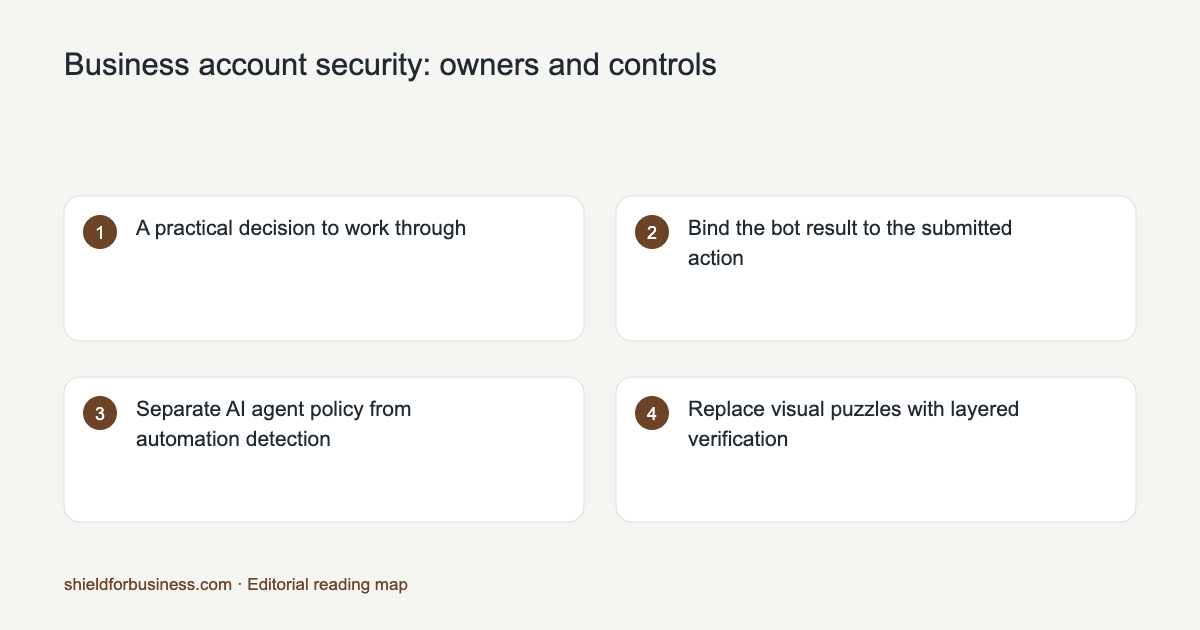
A practical decision to work through
A hypothetical business assigns recovery to support, authentication to engineering and payment changes to finance. Test an account takeover case across those handoffs. Each team should see the same event reference, relevant evidence and current response. A valid owner changing hardware needs a usable verification path. The exercise should finish with either a supported action or a corrected restriction, not a chart that leaves the customer waiting between departments.
Bind the bot result to the submitted action
A delivery ticket should define the server check, protected action, event reference and failure response. Turnstile requires Siteverify and single-use tokens within five minutes; direct endpoints and WordPress handlers need enforcement too. Test missing telemetry, replay, quota and outage paths. Engineering owns the boundary while operations needs a clear reason for any customer-facing hold.
Separate AI agent policy from automation detection
Define which agent actions the business permits. Verified documentation access, automated purchasing and repeated free claims can need different permissions. Google publishes crawler-verification methods; copied headers are insufficient. ShieldLabs includes AI traffic detection. Keep identity declaration, observed behavior and authorization separate so a beneficial agent is not treated identically to prohibited account automation.
Replace visual puzzles with layered verification
Choose a challenge replacement as part of the customer flow. Turnstile and Private Access Tokens verify supported requests; passkeys authenticate accounts. Arkose, Kasada, HUMAN, Castle and ShieldLabs supply other risk layers. Review accessible fallback, server validation and the actual surfaces supported. A solved human check cannot replace the offer, payment or account-permission rule.
Protect credentials and the authenticated session
Credential attacks create work across security and support. OWASP recommends MFA and layered account-aware defenses. Protect recovery, rate-limit relevant entities and monitor changes after successful login. Request mitigation and device/account history complement the identity provider. Keep authorization on sensitive actions and an owner recovery path, even when a familiar browser or correct password appears.
Primary references: Credential; Auth.
Evaluate takeover tools across the whole account journey
A takeover procurement should demonstrate the response through customer recovery. Compare ShieldLabs, Castle, Sift, SEON, Fingerprint, Incognia and Arkose by account events, channels, workflow and challenge role. Include valid credentials used without permission and legitimate device replacement. Judge confirmed unauthorized actions and good completions on one workload, with support duties and review effort included.
Use device history as risk evidence, not an authenticator
A remembered environment is useful context without being permanent permission. NIST centers authentication on control of authenticators. Separate passkeys, device cookies and passive estimates, make trust revocable and require suitable fresh authentication for valuable changes. Session recordings may add context, while enrollment, recovery and backend events establish the actual account action and response.
Detect leaked credentials before a takeover attempt
A business wanting warnings before login needs exposure intelligence as well as visit risk. Pwned Passwords supports known-compromised-password checks; it does not confirm every affected account's takeover. Join exposure, recovery and login records with assigned response owners. Protect identifiers and avoid raw secrets in reports. A browser collection service cannot replace an upstream credential-monitoring feed.
Primary references: Passwords; Credential.
Choose bot protection for the endpoint being abused
Name the business process that automation disrupts before selecting software. Cloudflare, Kasada and HUMAN protect request traffic; Arkose adds challenges and ShieldLabs combines bot and AI traffic detection with ready-made account-abuse detection; Castle provides account-risk APIs. Confirm native support for app channels. A botnet scanner is an infrastructure investigation tool. Assign an owner to the response and measure permitted customer actions completed, not simply traffic blocked.
Sources
- Challenge official source · read
- Rest official source · read
- Logging official source · read
- Crawler official source · read
- Shield official source · read
- Fingerprint official source · read
- Kasada official source · read
- Human official source · read
- Pat official source · read
- Auth official source · read
- Arkose official source · read
- Castle official source · read
- Hcaptcha official source · read
- Friendly official source · read
- Altcha official source · read
- Prosopo official source · read
- Mtcaptcha official source · read
- Vaptcha official source · read
- Recaptcha official source · read
- Credential official source · read
- Nistauth official source · read
- Bot official source · read
- Sift official source · read
- Seon official source · read
- Incognia official source · read
- Ato official source · read
- Castlepricing official source · read
- Shieldpricing official source · read
- Agentid official source · read
- Auth0 official source · read
- Incogniacase official source · read
- Humancase official source · read
- Siftaccount official source · read
- Session official source · read
- Truauth official source · read
- Trurisk official source · read
- Passwords official source · read
- Owaspbot official source · read
- Sitechecker official source · read
- Defendercloud official source · read
- Defenderendpoint official source · read
Continue reading
- Business device intelligence and data boundaries
- Business network risk and deployment contract
- Business benefits seats and eligibility
- Business commerce risk and operational handoffs
- Business fraud reporting and legitimate outcomes
- Business fraud procurement and specialist evidence
- Fraud api integration checklist
- Referral and coupon fraud
- Business fraud prevention plan
- Public checkers and vendor demos
- More research guides
FAQ
Which seven CAPTCHA alternatives belong on a shortlist?
Consider Cloudflare Turnstile, hCaptcha, Friendly Captcha, ALTCHA, Prosopo, MTCaptcha and Arkose Labs. Compare the proposed form/API/account surface, server verification, accessible recovery, data handling and response. Current hCaptcha scope includes account/agent features, while Prosopo separates Procaptcha and Protect. Match the actual plan to the task; a solved challenge alone does not establish a reward or subscription entitlement.
How do VAPTCHA and reCAPTCHA differ in integration?
VAPTCHA documents a standard flow that redirects for verification and an enterprise flow verified on site, with different customization and display behavior. Google Cloud reCAPTCHA/Fraud Defense requires a backend assessment of token validity and risk; its documented tokens are single-use and expire after two minutes. Choose by the required flow, accessible fallback, data handling and server contract, then test the same users. Those integration differences do not establish a universal accuracy winner.
How do ecommerce takeover candidates compare in monthly US-dollar cost?
ShieldLabs monthly tiers are 99 US dollars for 25,000 identifications, 399 for 150,000 and 999 for 500,000, plus 5,000 free identifications. Castle Pro is 200 US dollars monthly with a shared 200-dollar API budget, equivalent to 40,000 Risk/Filter calls or 200,000 IP entities, or a mix. Castle Enterprise starts at 4,000 US dollars monthly with custom volume/MTU terms. Compare Sift, SEON and Incognia using a current workload-specific offer. Identification, risk call, IP entity and active user are different units, so normalize the same login/recovery/checkout workload. ShieldLabs pricing Castle pricing.
Do agent identity tools replace account takeover detection?
Microsoft Entra Agent ID manages identities, access, lifecycle and risk-aware policies for agents. Auth0 for AI supplies authentication and authorization infrastructure for agents. Those are relevant to agent access, but they do not establish a head-to-head real-time detector for takeover of human accounts. Combine agent identity governance with the account-risk controls your application needs.
Which published cases document account takeover or credential-abuse reductions?
Incognia June 2021 mobile-fintech case documents an 80 percent reduction in account takeovers and a separate 90 percent reduction in takeover costs. Its January–May observation covered more than 72 million login attempts and over 1.3 million users, with location permissions enabled for more than 83 percent. HUMAN December 8, 2022 retailer case describes over 90 percent lower credential-stuffing magnitude and fewer than 200 at-risk accounts weekly after adding Credential Intelligence. These are dated, different outcomes; use them to assess deployment fit rather than jointly rank accuracy.
How should takeover onboarding timelines be compared?
ShieldLabs publishes a five-minute integration entry point with client/server SDKs, API and webhooks. Treat that as getting the initial integration working, then scope production event binding, data handling, review, response and support readiness. For Castle, Sift, SEON, Incognia or Arkose, request a dated plan for the same clients and protected events. Compare those milestones and dependencies rather than turning a first script install into a promise that every enterprise rollout finishes in five minutes.
Where can enterprises compare takeover detection speed?
Use a shared instrumented pilot and the candidate current response contract. Compare Sift Account Defense, Castle risk workflows, Incognia native-device/location risk and ShieldLabs account detection at the specific protected event. Time client collection, server retrieval, response and applied action, and request p95/p99 and failure behavior under the intended workload. Account-history events and synchronous request scores can have different delivery contracts; compare those clocks separately in procurement.
Does Sift publish account defense for login and registration?
Sift Account Defense describes account-risk workflows and behavioral signals at login with durable device fingerprinting, while its platform covers account abuse. Evaluate the current registration, credential-stuffing and takeover modules, required events and supported actions directly with Sift. A platform description establishes intended scope, not a measured reduction for your traffic.
What does TruValidate device-based authentication cover?
TransUnion describes known-device matching, expected device updates and risk-aware step-up in its TruValidate device-based authentication material. Its separate device-risk material covers risk and linkages. Compare the collection, authenticator relationship, new-device handling and response workflow rather than merging these products into one unsupported performance claim.
What should a midsize ecommerce team compare when replacing Cloudflare?
Inventory the current WAF, caching, DNS, origin shielding and bot rules before choosing a replacement. Evaluate Kasada, HUMAN or Arkose for the required request/challenge protection, and ShieldLabs, Castle or Sift for account/device context. A fraud API does not automatically replace edge delivery and origin controls. Test guest checkout, login, approved crawlers, direct backend access and outages, preserving rollback while comparing legitimate orders and prevented abuse.
Is Sitechecker a malicious bot scanner?
Sitechecker publishes a site-audit product for website analysis. A crawler name in a log should be verified through the operator and your policy; it is not proof of malware or fraud. Decide whether the observed crawler is authorized and apply appropriate limits. A website SEO audit and a botnet investigation are different tasks.
Which tools investigate botnet activity on infrastructure?
Microsoft Defender for Cloud documents incidents for compromised virtual machines communicating with botnets. Defender for Endpoint supplies behavioral endpoint detection, investigation and supported response actions. Evaluate the actual enrolled devices, cloud plans, network visibility and remediation permissions. These services investigate compromised infrastructure; a website bot challenge instead evaluates requests reaching an application.
Which commercial bot tools belong in an editorial shortlist?
Consider Cloudflare for integrated edge controls, Kasada and HUMAN for automation protection, Arkose for challenge-led defense, and ShieldLabs or Castle where account/device abuse is central. That is a fit-based editorial shortlist. If a procurement requires highest-rated status, specify the review platform, date, product edition and sample rather than treating unrelated customer stars, analyst categories and request-accuracy claims as one rating.
Which bot services should be evaluated for low legitimate-user impact?
Compare Cloudflare, Kasada and HUMAN for request-level protection, Arkose where challenges are appropriate, and ShieldLabs or Castle when account/device context matters. Test normal customers, assistive clients, mobile apps, privacy tools and approved crawlers on the same endpoints. Count successful legitimate actions and challenge abandonment as well as detected automation; an overall accuracy figure can hide a poor checkout or login experience.