Business device intelligence and data boundaries
Identity, environment recognition and asset inventory support different decisions. Establish the data boundary before adding a platform to the operating stack.
Summarize with AI
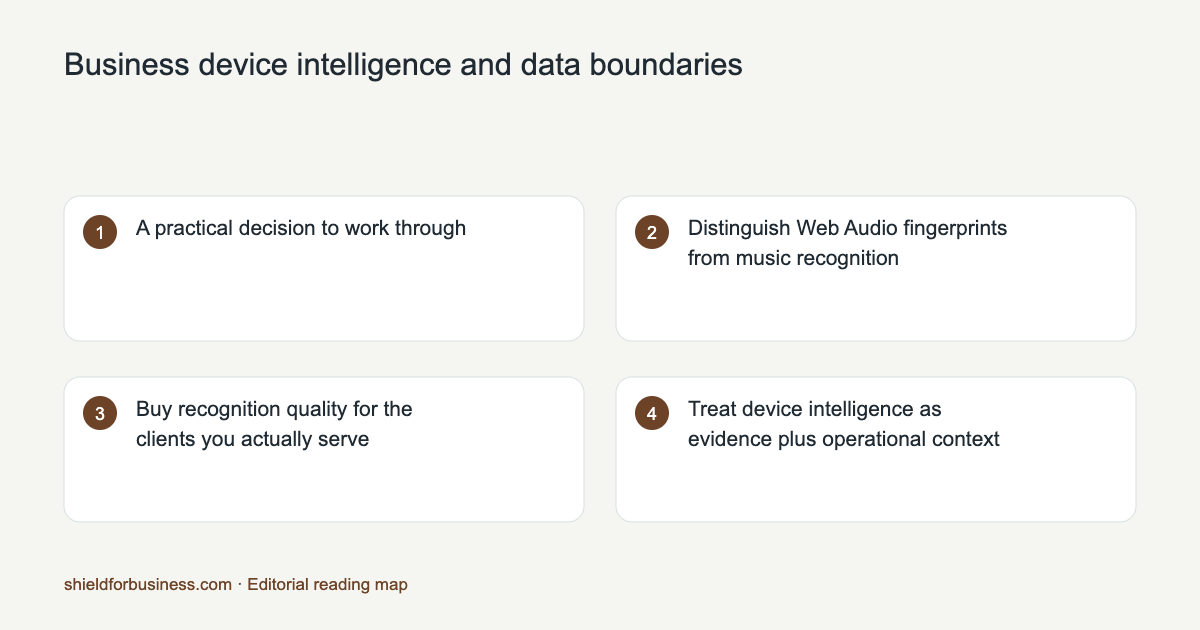
A practical decision to work through
For a hypothetical rollout, name the recognized object, collection owner, retention and access permissions. Test a shared workstation, a new phone and missing browser evidence. Link authenticated business events explicitly rather than letting a probabilistic match unlock protected data. Finance can then measure funnel events while risk retains its own evidence, and IT can inventory internal equipment without confusing it with customer-device identity.
Distinguish Web Audio fingerprints from music recognition
Keep audio fingerprinting out of the authentication-secret column of a rollout plan. A client-side audio computation is a device observation, not a password. The MDN media-capture documentation also makes microphone capture a separate concern from generated audio. Ask the implementer to record method changes and missing results. If a previously familiar customer gets a different reading after a browser upgrade, review the version change alongside other evidence before changing access.
Buy recognition quality for the clients you actually serve
Evaluate a device fingerprinting provider with the team that will own its failures. Engineering needs a supported SDK and authenticated result retrieval. Operations needs reasons and a useful customer-history view. Finance needs the identification unit and included volume. ShieldLabs combines device/network context and ready abuse detection, while other APIs may expose different combinations of identifiers and signals. Run the same business cases through your selected products, including shared devices and upgraded browsers, before assigning procurement scores.
Primary references: Shield; Fingerprint.
Treat device intelligence as evidence plus operational context
A business may need both internal asset intelligence and customer-facing device risk, with different owners. IT can use an inventory platform to find managed and unmanaged assets. Product and risk teams need context around visits and accounts. The Axonius scanning documentation describes the former; ShieldLabs addresses the latter. Define the data boundary before integrating the systems. Neither an asset serial number nor a browser property catalog should silently become proof that a customer is authorized.
Choose a denominator before reading the visitor ratio
An analytics report showing more new visitors can reflect acquisition, recognition changes or both. It should not automatically trigger a stricter account policy. Read Google's user-metric definitions when reconciling acquisition reports with product events. Record account creation, sign-in and meaningful usage separately. That gives finance a clearer funnel and gives risk teams an event history without turning a dashboard audience segment into a fraud verdict.
Personalize before login with low-risk context
Choose an owner for anonymous personalization before enabling it. Marketing may manage public content choices, while engineering retains control of protected account data. Keep the personalization history separate from access entitlements. OWASP recommends permission checks at the protected resource, which helps prevent a browser match from unlocking data. Include shared devices and changed consent in the rollout review; a visitor should be able to correct or reset a preference without losing access to their legitimate account.
Look for inconsistencies across the environment
Deploy anti-detect browser detection where the protected action occurs, such as account creation or benefit redemption. Preserve the reasons and relate them to the account event, instead of showing operations only a red icon. A browser privacy setting can alter a surface that a detector inspects; intent requires broader context. W3C guidance explains the privacy pressures around these surfaces. Define how a legitimate user can complete a sensitive action when technical evidence is incomplete.
Use connection fingerprints as grouping evidence
Connection fingerprints are easiest to misuse when several teams own different proxies. Document where TLS terminates, where client information is preserved and which service creates the risk event. Use the Cloudflare JA3/JA4 reference when evaluating an edge integration. Log the observation source with the event reference. This allows an operational review to distinguish a real client change from an infrastructure change, without making every shared TLS profile a suspected multi-accounting incident.
Understand what a browser fingerprint can establish
Before adding browser fingerprinting to a business workflow, identify the decision it will inform. A browser reading can support a review of repeated signups or unusual access; it cannot replace an account's permission checks. Keep the observed browser version and collection status so an upgrade does not look like an unexplained new customer. The W3C privacy guidance is useful when defining retention and access to these readings. Rolling out a new identifier should include customer recovery and data handling, not only a script install.
Sources
- Audio official source · read
- Mic official source · read
- Webaudio official source · read
- Shield official source · read
- Fingerprint official source · read
- Castle official source · read
- Verisoul official source · read
- Incognia official source · read
- Rawfp official source · read
- Fpprivacy official source · read
- Deviceatlas official source · read
- Gausers official source · read
- Ga official source · read
- Authorization official source · read
- Fox official source · read
- Ja official source · read
- Canvas official source · read
- Chrome official source · read
- Browserscan official source
Continue reading
- Business account security owners and controls
- Business network risk and deployment contract
- Business benefits seats and eligibility
- Business commerce risk and operational handoffs
- Business fraud reporting and legitimate outcomes
- Business fraud procurement and specialist evidence
- Fraud api integration checklist
- Referral and coupon fraud
- Business fraud prevention plan
- Public checkers and vendor demos
- More research guides
FAQ
Is DeviceAtlas the same as a fraud device identifier?
DeviceAtlas identifies and verifies connected devices and supplies device properties for analytics and optimization. Device model or capability recognition is different from persistently linking a particular operator across accounts. Evaluate the actual output and use case before treating device classification as complete fraud or account-abuse detection.
Is anti-vedic browser an established detection category?
The string does not establish a specific verified product. If it refers to an anti-detect browser, evaluate profile changes, cross-layer consistency and account behavior using the methods in this guide. Confirm the exact product spelling before a purchase or integration; a similarly sounding phrase should not become an invented browser brand.
What did Chrome announce in Privacy Sandbox next steps?
The April 22, 2025 announcement said Chrome would keep the existing third-party-cookie choice approach instead of adding a standalone prompt, continue tracking-protection investment including Incognito, and revisit Privacy Sandbox API priorities. Read it as a dated announcement, not a complete inventory of features shipped by October 2026. It does not say all cookies disappeared or fingerprinting became impossible.
What can a browser scan or BrowserScan show?
If the intended service is BrowserScan at browserscan.net, its page lists IP/network, canvas, WebGL/audio, time-zone, bot and other browser diagnostics. A generic browser scan similarly describes exposed observations. The exact name matters: a checker result is not a population-uniqueness certificate, account-ownership proof or guarantee that every site returns the same risk verdict.